


Impacts all over the world
In today’s globalised world, our consumption of products and services causes environmental and social impacts all over the world. Many of the impacts relate to the extraction of raw materials, such as deforestation in tropical regions, increased water scarcity due to irrigation or violent conflicts related to mining activities.
We urgently need to reduce the global impacts of our raw material use and to establish a sustainable economy and lifestyles that respect the planetary boundaries. To achieve this, detailed knowledge on the various impacts of specific consumption areas, supply chains and raw materials is required.
Current models used to trace material flows and related impacts along international supply chains and to calculate consumption-based (footprint-type) indicators mostly operate on the national level. But environmental and social conditions vary significantly over time and space. In order to reflect these differences, models need to move from the national to a much more detailed spatial level.

There is an urgent need to transform our production and consumption patterns and reduce our global impacts
Moving material flow and footprint analysis from the national to the spatially explicit level
The objective of
FINEPRINT was to advance current footprint models through developing
new methods for assessing global material flows using high
geographical resolution.
With this new methods, we performed spatially explicit analyses of worldwide raw
material flows
embodied in products and services and assess the associated environmental and
social impacts around the globe.
A major step forward in material footprint modelling
From extraction to consumption
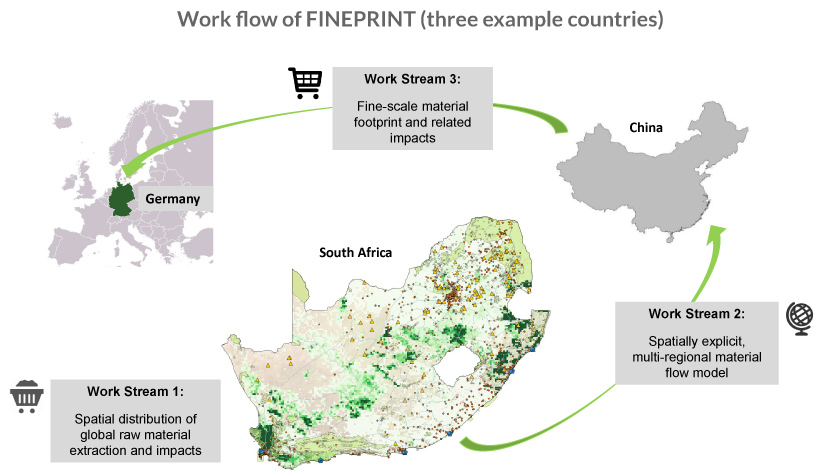
FINEPRINT was implemented by means of three work streams.

Extraction
We investigated the spatial distribution of global raw material extraction on a high level of geographical detail and analysed its relations with environmental and social impacts, covering issues such as water scarcity, deforestation and mining conflicts.

Trade
We created spatially explicit material flow models by tracking raw materials from the location of extraction via major transportation facilities such as ports to processing industries in importing countries, and further on to final demand in consuming countries.

Consumption
We performed highly detailed assessments of global material flows and footprints and their environmental and social impacts, tracing raw materials required for all products and services to their local origin worldwide.